
Respectable Citizens
A Curious Month in 1928
As my longtime readers know, I've spent many enjoyable hours wandering through the online newspaper archives, researching the writings of my great-great-uncle Crab Breland. Most of what I’ve found have been articles reporting on crops, church meetings, school events, and the everyday happenings of Big Level, Wiggins, and Stone County, the area where I grew up. Occasionally I stumble upon something unexpected. This week I came across four separate items published during a four-week period in the summer of 1928. Each incident involved an argument. Each involved a knife. And each left someone bleeding.
It's been several years now that I’ve been engaged in this “deep dive” through the Biloxi-Gulfport Daily Herald and other newspapers along the Mississippi coast, collecting excerpts related to my family history and the history and development of Big Level and Stone County generally. I started with Crab’s earliest articles published in the 1880s and I’ve been working chronologically up through the decades of his long career. It’s been a pleasant and rewarding retirement pastime for me. And I’m not done yet. I’ve made it up to 1928 and have almost 20 more years to go.
Through it all, my impression has been consistent: In general, the land of my youth was relatively peaceful and orderly, inhabited by church-going farmers, merchants, and professionals, respected citizens all. Oh, there were reports of the usual disagreements and lawsuits. There were occasional reports of robberies and other thievery, even a murder or two. But the most violent crimes were usually committed by outsiders, violence among the local citizenry was a rarity. Then I came to June of 1928.
Within a few short weeks, there were four separate knife assaults, and the most surprising thing was not the violence itself, but who was wielding the knives. Was it exceptionally hot and dry that June? I haven’t yet investigated that point, but it didn’t appear to be the case. Whether it was the heat, personal grievances, or mere coincidence, something seemed to be putting an edge on the tempers of several Stone County folk that summer. Let me tell you about these shocking incidents.
The first involved a teenaged boy who had been caught sneaking into the Palace movie theater in Wiggins. It was reported that when he was confronted by George Anderson, the attendant, and asked to leave, the boy pulled a knife and cut George severely, causing him to lose a lot of blood and require several stitches. The assailant escaped into the night and his identity was not discovered. Whether he was a local boy or not, we might surmise that the assailant was a hoodlum of a type—every town usually has one.
Frankly, I didn’t find this incident all that surprising and I would have thought no more about it, except a few issues later I came across another knifing incident. Then another. And then still one more.
That second occurrence involved the sons of two prominent Big Level farmers. One was age 19 and the other 20. They were neighbors living on adjacent farms in lower Big Level. The report did not say what the argument was about, but stated that the aggressor “struck the victim on the jaw, knocking him unconscious for a time, and cutting a hole that extended entirely through that part of his face.” It was believed the wound was caused by a pocketknife or some similar weapon the young man had hidden in his hand. The victim was taken to Wiggins where a physician dressed his wound. His assailant was arrested later that night and placed under bond the following day.
What gets me is that these two young men were not strangers—not to each other nor to the community. They probably played together as children. They attended the same church, school, and community gatherings. Yet, in a fit of anger, one drove a knife completely through the other’s cheek.
By the way, though these sons and their fathers have been dead for several years, I know the two families and many of their descendants—I’m even related to some of them. For this reason, I’ve chosen not to divulge their names here.
I found the third incident to be even more surprising. It happened in broad daylight on one of the main streets in downtown Wiggins, in front of the telephone exchange building. It involved two local dentists, Dr. Leggett and Dr. Chiles. Again, it was not reported what the argument was about, but Dr. Leggett was left cut badly about the neck and face. Dr. Chiles, the assailant, immediately went to the courthouse and turned himself in, where he was charged with assault and released on bond.
Both of these men also knew each other well. They had been practicing their profession in offices across the street from each other for some time. Crab stated, “This occurrence is greatly regretted by the friends of the parties and has caused considerable feeling among the people of the town.” No doubt that was true. These were grown men, educated men, pillars of the community. And yet one slashed the other severely about the face and neck.
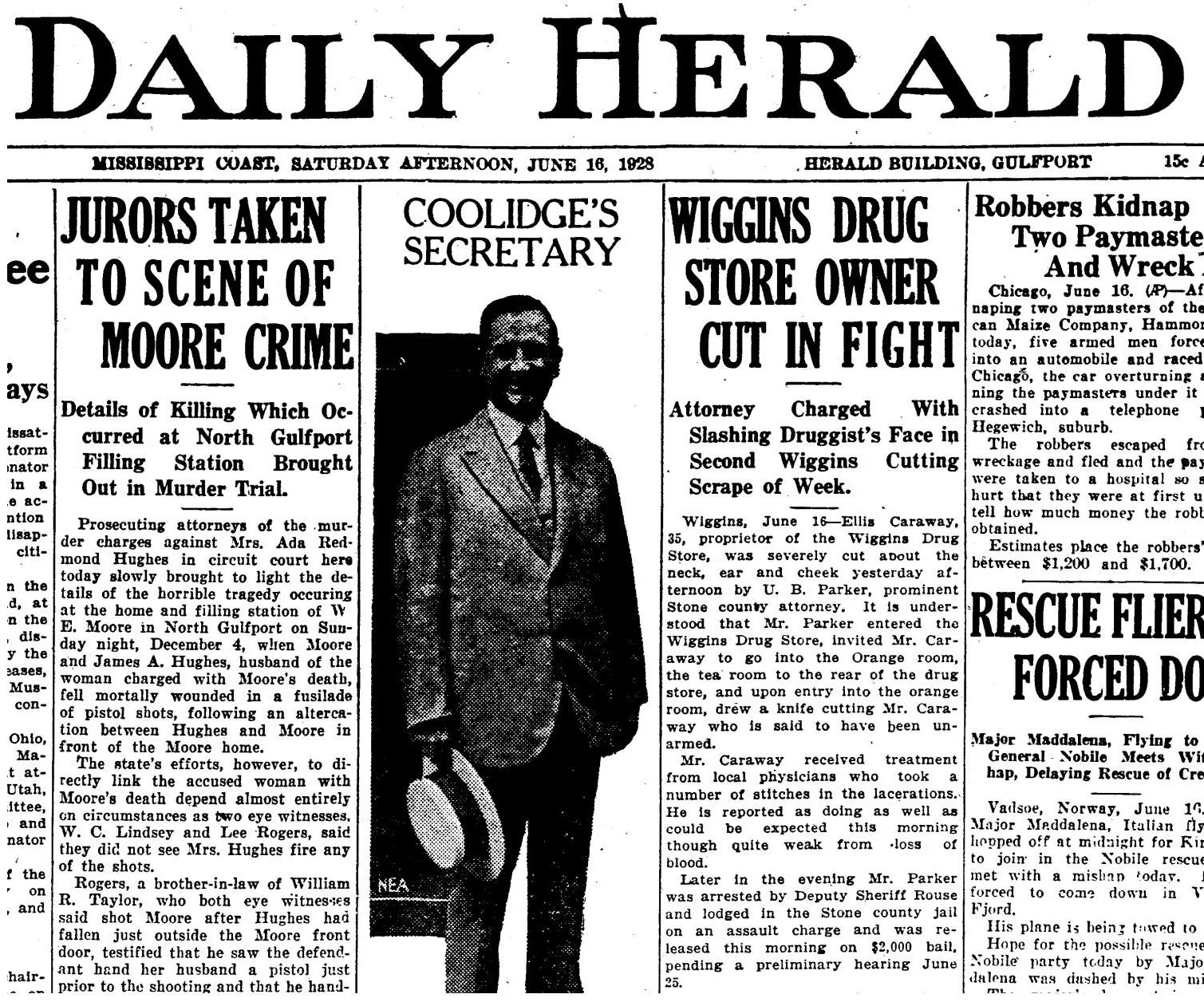
A clipping from the front page of the June 16, 1928, issue of the Biloxi-Gulfport Daily Herald.
Courtesy of NewspaperArchives.com
I couldn’t believe it when I saw the news of the fourth incident that happened just five days later. The headline and article made the front page: “WIGGINS DRUG STORE OWNER CUT IN FIGHT: Prominent Attorney Charged With Slashing Druggist’s Face in Second Wiggins Cutting Scrape of Week.” Here’s the complete transcript:
“Wiggins, June 16—Ellis Caraway, 35, proprietor of the Wiggins Drug Store, was severely cut about the neck, ear, and cheek yesterday afternoon by U. B. Parker, prominent Stone County attorney. It is understood that Mr. Parker entered the Wiggins Drug Store, invited Mr. Caraway to go into the Orange room, the tea room to the rear of the drug store, and upon entry into the room, drew a knife, cutting Mr. Caraway, who is said to have been unarmed. Mr. Caraway received treatment from local physicians, who took a number of stitches in the lacerations. He is reported as doing as well as could be expected this morning though quite weak from loss of blood.
Later in the evening Mr. Parker was arrested by Deputy Sheriff Rouse and lodged in the Stone County jail on an assault charge and was released this morning on $2,000 bail, pending a preliminary hearing June 25. Mr. Parker would make no statement as to the cause of the trouble and Mr. Caraway was too ill to talk. The fight is alleged to be the out-growth of an argument over Dr. W. J. Chiles, a dentist here, who engaged in a cutting scrape with another dentist, Dr. J. A. Leggett, on the street last week. At that time, Dr. Leggett was severely slashed about the head and body and is still in a serious condition at the home of relatives in D’Lo. Doctor Chiles was arrested but was released on bond.”
Holey Moley! By this point I was no longer surprised by the violence. I was surprised by the names attached to it. These last two incidents are the most shocking and perplexing items I’ve encountered in all of my digging in these old archives. These were not drunken brawls out behind the Finkbine sawmill. These were not teenaged delinquents engaged in petty crimes in the dark. These were not outlaw strangers moving through town bent on committing their malevolent mayhem. This was the county’s legal and business elite. They weren’t living on the fringes of society. They were society.
Urithon B. Parker was no hot-headed youth. He was 46 years old at the time and had been practicing law in Wiggins since passing the bar 22 years earlier. His reputation as a lawyer was based on the fact that he rarely lost a case. He was one of the most successful and respected men in town and the whole county. He represented the Bank of Wiggins and served on numerous civic committees. And given that his altercation with the druggist seems to have been related to the case involving the two dentists, I obviously have more digging to do. I can’t wait to get back to my research to see if I can unlock this mystery.
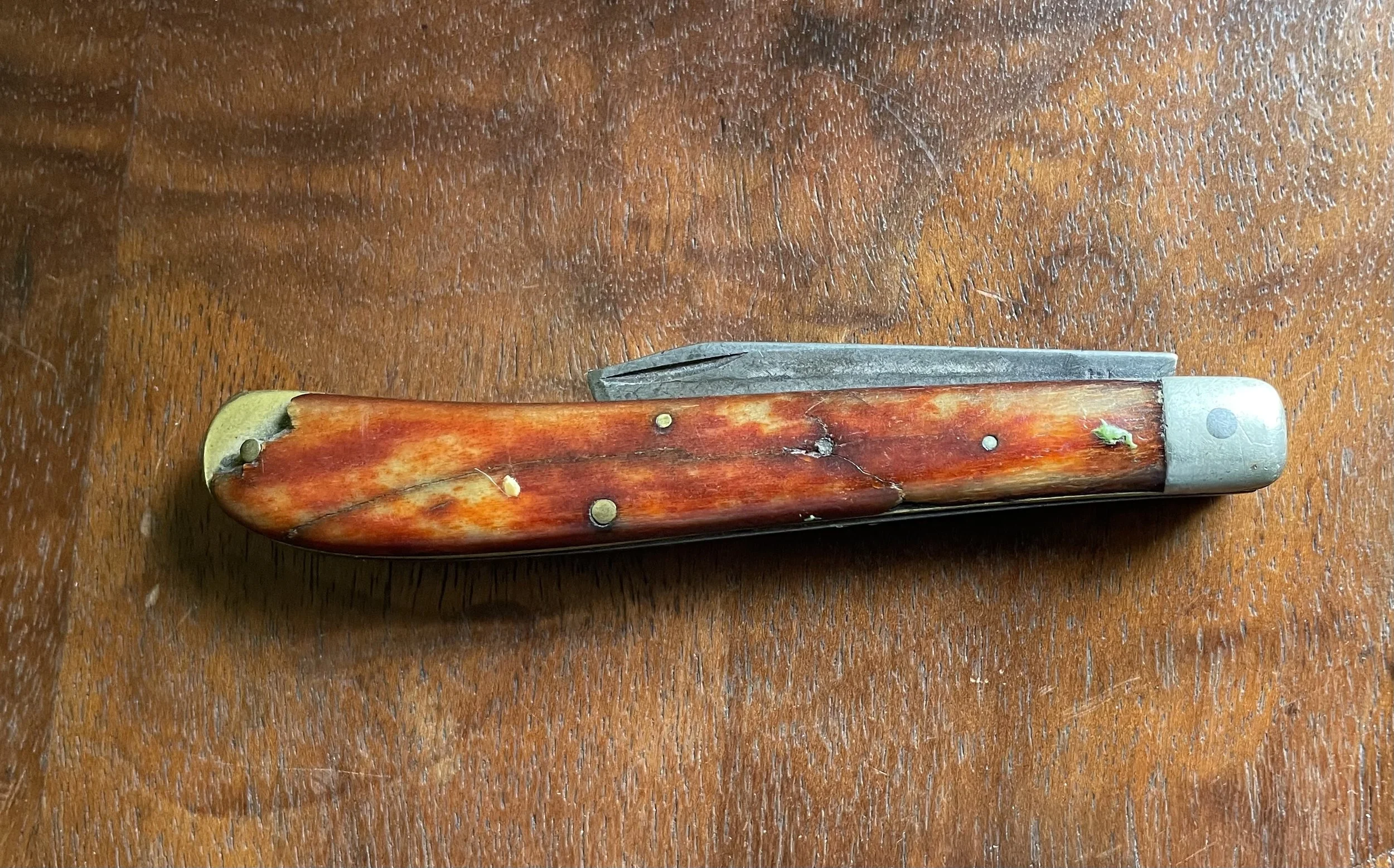
This is Daddy’s well-worn pocketknife. It’s the only one I remember him using. He had it with him whenever he had pants on—at work, play, church, ballgame, hunting or fishing. I have vivid memories of him emptying his pockets after a long day and placing it on the fireplace mantle at night with his billfold, then putting it back in his pocket the next morning. I can still see him sharpening it with the whetstone that he also kept on the mantle. The blades were getting awfully thin after decades of repeated sharpening. I inherited the knife after he died in 1967. I didn’t use it often, but it felt at home in my jeans pocket. It almost broke my heart when I carelessly broke off an inch of the primary blade 30 years or so ago,
So, what was in the air that summer? Were these cutting events in rapid succession mere coincidence? Was it the farm-boy culture of that era that made knife fighting such a commonplace way to respond to arguments? I would’ve thought that fistfights would have been much more prevalent—I witnessed plenty of those in my youth. But I have to remind myself and my younger readers that back then, particularly in the rural South, almost every adolescent and adult male carried a pocketknife daily. It wasn't viewed as a weapon. It was a necessary tool. A farmer carried one. A merchant carried one. Even lawyers and dentists carried one. I still have the knife, heavily worn from repeated sharpening, that my daddy carried. And I have some that I carried over the years when I was younger. There may have been some fisticuffs involved in each of these scuffles, and it just wasn’t reported. Even so, something elevated these startling altercations beyond mere words and fists to a whole ’nother level.
I have always pictured the Big Level and Wiggins of that time as a quieter and gentler place than the crowded world we inhabit today, where reports of assaults with knives and guns seem to frequently make the news. In many ways those earlier times probably were. Yet these four newspaper accounts remind me that human nature remains remarkably consistent over time.
A century ago, people worshipped together, farmed together, conducted business together—and, apparently, when tempers flared, they occasionally cut one another with pocketknives. These archival articles haven’t changed my opinion of these people, my people. They’ve simply made it a more realistic one. Yes, these were respectable citizens. But they were also human.
A Word to Ponder
altercation (n.): a heated or angry dispute; noisy argument or controversy. From the Latin noun altercatio. Etymologically, the word literally translates to “speaking back and forth with another person in an alternating fashion.” The original historical sense implies an alternating exchange of words, which naturally evolved into the modern idea of a heated, quarrelsome argument. In contemporary American legal and police jargon, it often includes physical scuffling and minor injuries as well.
etymonline.com
Song of the Day
“Bad, Bad Leroy Brown” by Jim Croce (Life and Times, 1973)
“Well, the two men took to fighting
And when they pulled them from the floor
Leroy looked like a jigsaw puzzle
With a couple of pieces gone”