
An Arabian Adventure
Saturday, a few days ago, I drove down to Big Level from my home in Hattiesburg to have coffee with my good friend and cousin, Bill Breland. Bill’s wife, Priscilla, had recently lost her battle with cancer, and a visit was overdue. Bill, or Billy, or Billy Hayes, as his mother always called him, is my closest cousin in age. His dad and mine were first cousins in that his grandmother (my great-aunt Minnie) was a Lott, my granddaddy’s sister. That makes Bill my 2nd cousin. Because his dad was a career army man, Billy lived all over—Germany, New Mexico, and Alabama to name a few places where his dad was stationed and where he went to school—but he spent part of most summers during his growing up years with his grandparents on their large farm in Big Level. The times Billy’s mom (Miz Bonnie) and my Mama arranged for us to visit and have sleepovers were always fun and hold many fond memories for me.
With a beautiful, sunny autumn sky in front of me and with the traffic thinning out, it was a perfect time to reminisce and reflect. As I approached the bridge over Black Creek on Highway 49 at Brooklyn, I thought of the day, near the end of our senior year at Stone High, that Billy and I had ridden our motorcycles on this same roadway from our homes in Big Level up to Hattiesburg and back. On the return trip, we got caught in a sudden cloudburst and pulled off the highway and parked under this very same bridge to wait it out. That was five and a half decades ago, and that bridge, though showing its age, remains the same. In many respects, that applies to me, too. However, my memories of that day haven’t dimmed a bit. As I drove on, I began to recollect some of the many other escapades and experiences that he and I shared back in our youth, before marriage and careers pulled us in different directions.
I recalled playing in the sandy-bottomed hollow behind my house and in the big barn at his granddaddy’s place. I thought of the time I accompanied Billy and his mom and his grandparents to a noon revival meeting way out at Mars Hill Baptist Church, a little old-time country church in the Deep Creek community in the northeast corner of Stone County. That was in the early 1960s when I was about 10. We traveled for miles along a dusty and sandy dirt road off of the highway before finally getting to the church. Stepping out of the car and walking into that small, old church house was like stepping into land that time forgot.
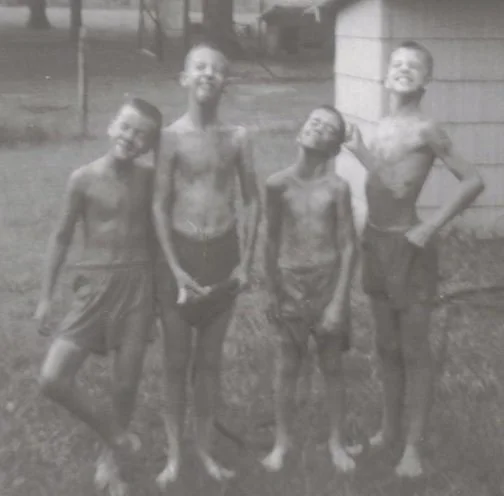
Four muddy boys about to hose off after a fun afternoon playing in the hollow behind my boyhood home in Big Level in the aftermath of a heavy summer rain.
L-R: my brother Johnny, cousin Billy Breland, cousin Kenny Lott, and 11-year-old me. (Lott family photo, Summer of 1965)
I remembered the summer evening when Miz Bonnie dropped us off at the Straub Theater in Wiggins to catch a Glenn Ford western. We were 12 years old, and I don’t know about Billy, but it was the first time I’d ever been in a movie theater without an adult. What I didn’t know until later, when Bill told me, is that Bonnie drove around the block after letting us out and came back, bought a ticket for herself and slipped into the balcony to keep an eye on us. She then slipped back out as the movie was ending and waited in the car for us. That was back when the theater was still segregated and the balcony was designated as colored-only and had a separate entrance. The thought of a white woman sitting up there alone made a lasting impression on the sheltered and naïve country boy that I was back then.
Bill’s dad retired from the military in 1970 and they moved back to Big Level, into the house trailer he’d put on a few acres of the family farm a few years before. This was in the middle of our senior year of high school, and Bill was able to graduate with me at Stone High in Wiggins in May of ’71. As a celebration of sorts, he and I made an overnight float trip down Red Creek, cooking and sleeping on a sandbar, and ending up the next morning at the Ramsay Springs bridge, where his Dad was patiently waiting for us. I have no recollection of how long he had to wait.
That fall saw us both enroll at the local junior college, where we roomed together in one of the dorms until Gena and I got married with one semester left in our sophomore year. Bill was a groomsman in our wedding. A few months later, I was the best man in his wedding when he and Priscilla were married. Gena and I moved to Cleveland, Mississippi, where I enrolled at Delta State University. Bill joined the Army, and he was off to boot camp at Fort Jackson, South Carolina. And then, like I said, marriage and careers. . . the years rolled by. C’est la vie.
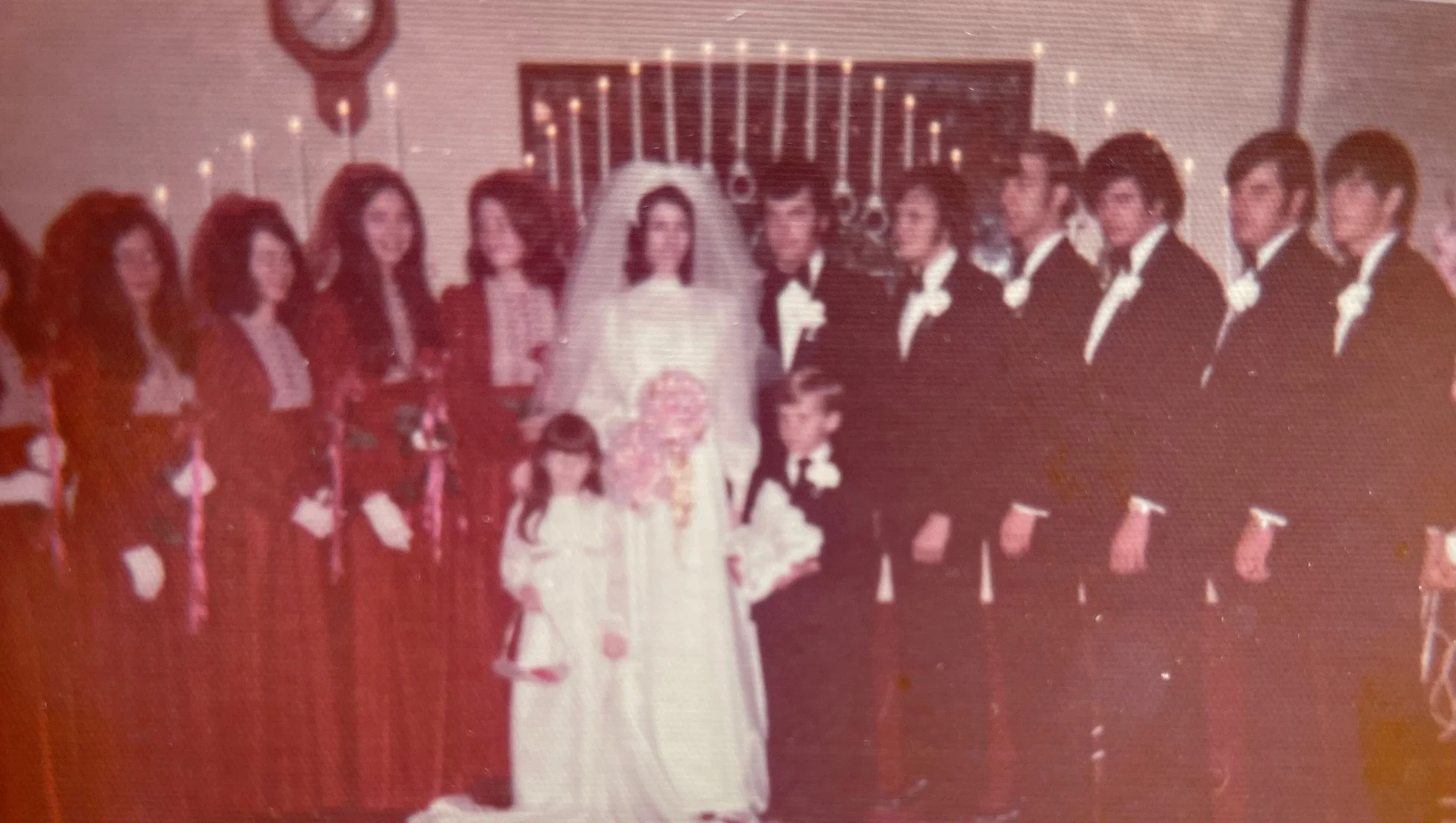
The whole wedding party at Gena’s and my wedding, minus Pauline Tanner, the 5th bridesmaid who’s cut off on the left side of this poor-quality family photo. Bill Breland is the sandy-brown-haired fellow 4th from the right. (December 23, 1972, Pineview Baptist Church, Agricola, Mississippi)
Army life suited Bill and he stayed in for 20 years. It’s what he’d grown up with; Priscilla, too, as her dad was also a career military man. We didn’t see each other much through the years, but I would hear this or that from his mom and dad when I’d occasionally them on our trips to Big Level. I learned of his tours in South Korea and Germany and of his life in Fort Bragg and other army bases around the U.S. I’m sure my mother would also pass along to them a few of the happenings of my career and family.
Bill became a helicopter pilot and later a flight instructor training other helicopter pilots, and later still an instructor training pilots to be flight instructors. He flew Vietnam-era Hueys mainly, which were for decades the military’s most versatile utility helicopters. They were used for troop and cargo transport, medical evacuation, and support in reconnaissance, search and rescue, and numerous other roles. And that brings me to the heart of the story I want to tell today.
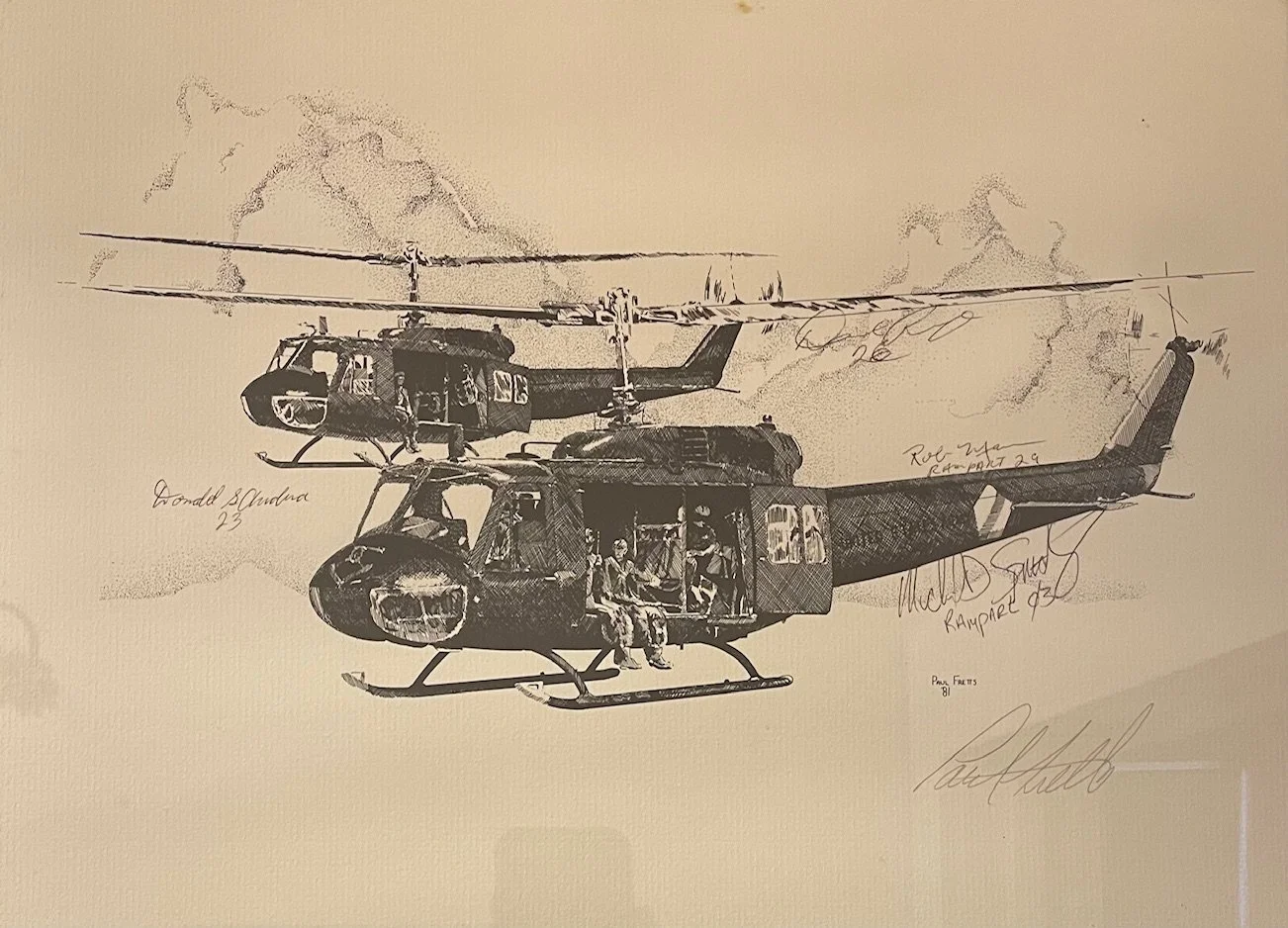
A 1981 drawing of two Huey helicopters by Paul Fretts, and presented to CW3 William H. Breland by some of his crewmen,
As I turned in to the lane leading up to Bill’s country home on the family farm that he inherited from his father, and that his father had inherited from his father, I was still lost in my reminiscing. Specifically, I was thinking about that amazing coincidence that happened while Bill was deployed to Saudi Arabia and Iraq during Desert Storm. When Bill came out to welcome me, he told me that he was also just thinking of it. Later, over coffee on his porch, he recounted the incident while I recorded it. Here it is in his words:
It was in 1991, Desert Storm; the actual ground war had just begun. This was like 30 days after the war started. The Air Force had been bombing the crap out of Iraq. Well, the plan was for the assembled forces, which included a lot of people and equipment, to start the ground offensive. That was in February. Everything was moving very fast, including all of the combat units, armor units, and infantry units. In fact, everything was moving a lot faster toward Iraq than was anticipated, as was the headquarters for 18th Airborne, which was who I worked for. My unit was attached to the 18th and flew support missions for them, generally carrying people and stuff.
On the second day of the ground offensive, I got a mission to pick up the Chief of Staff for the 18th Airborne, a full bird colonel, as they were moving the TOC (tactical operation center) for the corps to the north into Iraq from where it was in Saudi Arabia, south of what we called Tap Line Road, which was along the oil pipeline. They were moving the operation center about 150 miles or so north. My mission for the day was to transport the colonel to the new TOC location. All of his people had loaded up the equipment, maps, everything they use, and themselves, and were en route by trucks and jeeps to a location in Southern Iraq. My job was to pick him and take him to the new location.
It was me and the copilot, and the crew chief. We picked up the colonel and some tires and loaded them all up in my Huey and took them north. You have to understand aviation units in those days did not have GPS; we didn’t even have satellite communications. It was all old-fashioned line-of-site radio communications and navigation using a map and a clock. So, we attempted to find this intermediate location called by the codename White Operation. We headed that way knowing we could land and get fuel when got there, but the White Operation unit had already moved north. There was no one there and so there was no fuel. We then took off to the next spot where we thought they’d be. Same thing; nobody was there. The whole ground offensive was moving so quickly, the unit we had hoped to find had already moved north again. We made a couple of more stops, but couldn’t find the location with the inadequate communication available. By this time the colonel was mightily agitated, but for it’s worth, he had his maps and he couldn’t find the location, either. At this point, getting fuel for the Huey was now top priority; I was literally just flying on fumes. Finally, I said to the others, “Well, there’s a hilltop up ahead, let’s go up there. That way maybe we’ll be able to communicate with somebody to bring us a rescue helicopter.” And then, as I was on the final approach to the top of this hill, my gauge told me I had already flown over18 minutes since the 20-minute fuel-warning light had come on. But when I flew up to where I could see the other side of the hill, I saw a road with about 15 or 20 5,000-gallon fuel trucks stopped alongside it. Well, glory be!
I made my approach over the hill and landed on that road next to one of the fuel trucks. Just as I sat the Huey down, the blades stopped, its 209-gallon fuel tank was flat empty. I got out and stood there in amazement at our good fortune. Momentarily a soldier came over to greet me, a Staff Sergeant. The first words out of his mouth were “Hi y’all doing?” By that, I knew immediately he was from the Southern U.S. I asked, “Out of all these trucks, you got any helicopter fuel?” “I shore do!” was the reply. After I told him the specific kind of fuel I needed, he directed an 18-wheeler parked a few yards away to come refuel my Huey.
It turned out that this Staff Sergeant was over a National Guard unit from Lucedale in George County, the next county over from Stone and 25 miles from Big Level. Now, three months before all this happened, Russell‘s wife, Gena, who happens to be from George County, had written me a letter, saying that her little sister had recently joined the Guard and was being deployed to Saudi Arabia. Gena asked if I would be on the lookout for her. I just chuckled to myself at that, as I know Gena had no clue that there were over a half a million troops coming in here, and there was no way that I could find her sister without actually knowing the name of the unit she was in and several other details. But I remembered that letter and how sweet it was. So, when I was talking to this sergeant from Lucedale, I asked, “You got any girls in your unit?” He said “Yeah, we got a few. What kind of girl are you looking for, Black girl or white?” I said, I’m pretty sure she is a white girl, but I don’t remember her name.” He pointed to the next truck over and said, “Well there’s one right here. She might know who you’re talking about.”
I went over to this girl sitting in the driver’s seat. When she opened the door, I introduced myself and I told her who I was looking for. She almost screamed, “That’s me!” She then jumped down from the truck and hugged my neck! She was so happy to see somebody that knew that she existed out there in the middle of a desert in southern Iraq. We visited for a little bit, and I got my copilot to take a couple pictures of us with the little Kodak instant camera I carried in my pocket back then. Shortly, he and I got back in the helicopter and flew off. The TOC wasn’t very far from there, so we dropped off the colonel and called it a day.
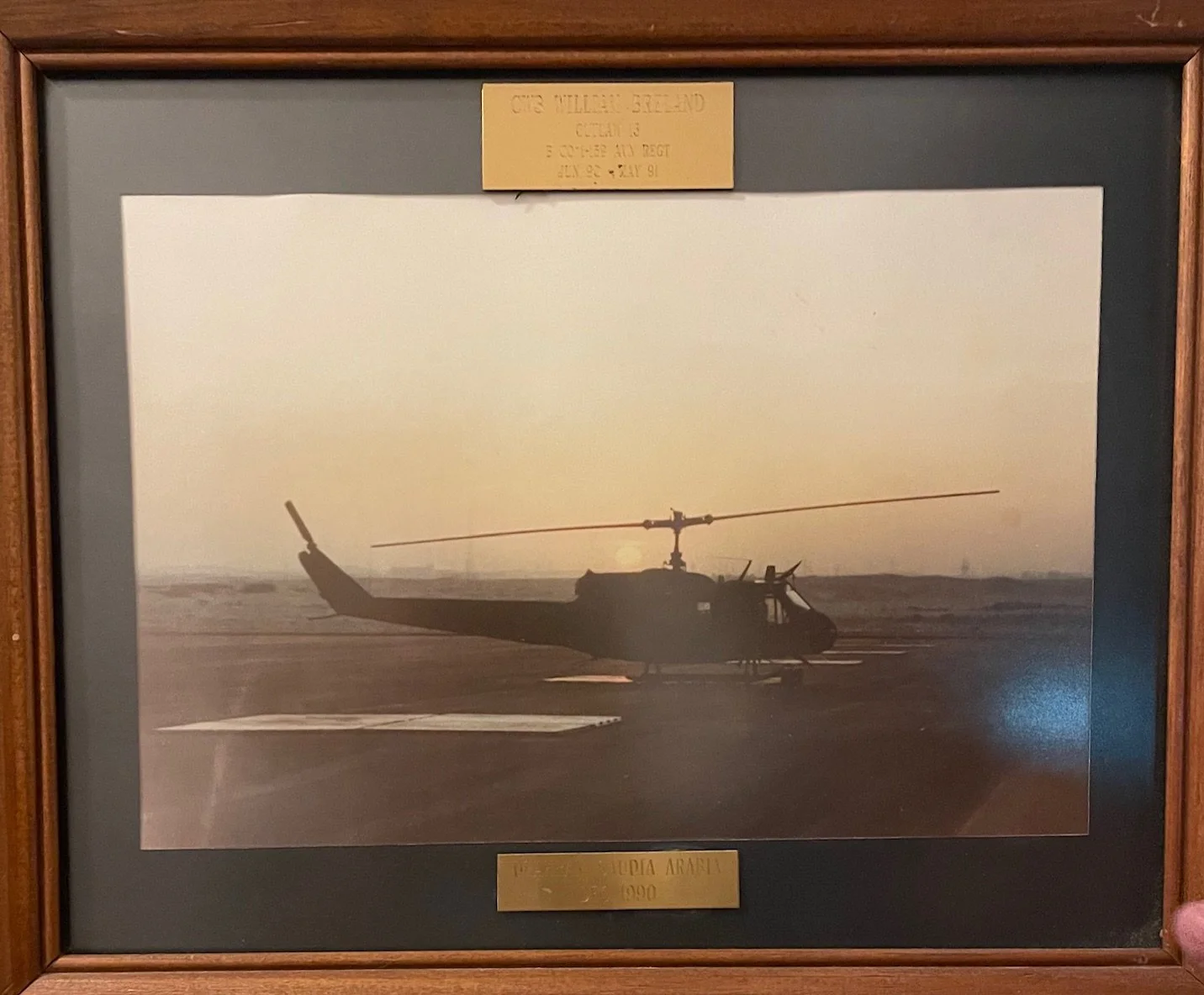
A photo of CW3 William H. Breland’s Huey helicopter in Saudi Arabia. It was taken in December of 1990 shortly after his deployment during the Desert Storm conflict.
And what a very good day it was! For Bill to find that caravan of fuel trucks at the very moment his helicopter hit empty is amazing enough, but then for him to find my sister-in-law within a matter of minutes in that very spot in the caravan is an astoundingly remarkable coincidence. And for me, the knowledge that these two close relatives of mine were on life trajectories that intersected for that brief moment in an Arabian desert halfway around the world, in the midst of a war no less, simply blows my mind. I have goosebumps even now as I write this.
By the way, that 27-year-old “girl,” is my sister-in-law, Luke Jones, one of Gena’s three younger sisters. Her full name is Eulinda Luke Jones, but she prefers and has always gone by her middle name. How she came to have a boy’s name is a story for another day.
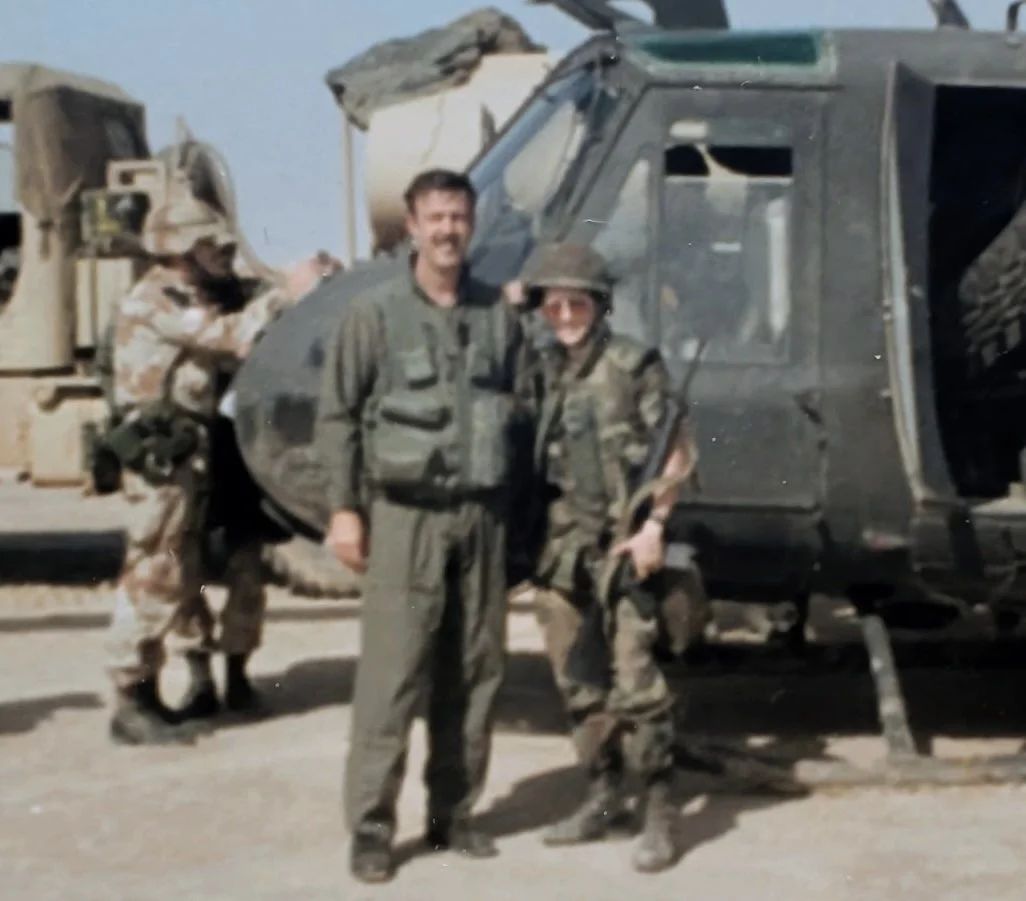
My cousin, Bill (left), standing with my sister-in-law, Luke, after an amazing chance meeting in the desert of southern Iraq during Operation Desert Storm.
William H. Breland family photo, February 1991
As a final aside, a year ago, in my “Bagel or Beignet” post, I wrote about what my friend, Paul Laughlin, calls the most surprising coincidence that he’s ever personally experienced. Well, Paul, I’m not trying to top you, but I think this Desert Storm coincidence with Bill and Luke is just as amazing, if not more so. And while I wasn’t there in that Arabian desert that day to personally experience it, I sorta was, as there would’ve been no coincidence without me in the equation.
A Term to Ponder
The "Huey" helicopter: The Bell UH-1 Iroquois (nicknamed "Huey") is a utility military helicopter designed and produced by Bell Textron Inc., the American aerospace company. The helicopter earned its nickname “Huey” from its original U.S. Army designation, HU-1 (Helicopter, Utility). While its official designation was later changed to UH-1, the phonetic pronunciation of "HU-1" stuck as a popular and enduring nickname.
Source: wikipedia.com
Song of the Day
“Help!” by the Beatles (Help!, 1965)